WHERE TECHNOLOGY MEETS GENEALOGY

The Computer Genealogy Society of San Diego meets on the 3rd Saturday of each month (except December) from 9:00 a.m. to noon on the campus of UCSD, University of California, San Diego.

Visit our website for more information and driving directions.

Wednesday, August 19, 2015

Meeting Results of August 15, 2015

MEETING Results

The Computer Genealogy Society of San Diego met on 15 August 2015 on the campus of UCSD, University of California, San Diego.  The meeting was called to order at 10:04 am to discuss and vote on the dissolution of CGSSD.  Voting results were as follows:

25 votes for dissolution of CGSSD
13 votes against dissolution of CGSSD

After the vote, there was a break followed by program:  "Using FamilySearch Digital Microfilm to Find Genealogical Records" presented by Randy Seaver.

Thank You Randy for your presentation.

Linda Brady
CGSSD VP-Admin

Sunday, August 16, 2015

Tribute to Joan Lowrey

I feel compelled to say a few words about Joan Lowrey. This is not an obituary or a remembrance, for Joan Lowrey is very much alive and active as a genealogy researcher. However, with the dissolution of the Computer Genealogy Society of San Diego and its absorption into the San Diego Genealogy Society, it seems appropriate to give Joan Neumann Lowrey due credit for the contribution she has made to genealogy in San Diego and the many people she has touched.

Joan has been involved with computers before there were computers as we know them now. With a BA in Mathematics, she programmed early analog military computers and was involved in several high tech companies in San Diego.

But it's as a researcher and teacher that we know her best.  She became interested in her family's heritage and used her computer skills to augment her research talents. She researched the genealogies for others, particularly those with German ancestry like hers.

Joan wrote a user's guide for several versions of the early genealogy program Personal Ancestral File in the early 1990s and, together with Donna Przecha, wrote "Guide to Genealogy Software" in 1993. She organized many students of her PAF classes into a PAF user group that grew into the Computer Genealogy Society of San Diego, which she founded. She was a frequent speaker at national genealogy conferences in those days, promoting the use of computers for genealogy and reviewed utilities and other software useful for researchers.

Not only did Joan serve as President of CGSSD for many years, she edited the CompuGen newsletter, the forerunner of this blog. She wrote many important articles and reviews for the CompuGen and encouraged others to make contributions, often drawing them out of their comfort zone. She was also very involved with the Germany Research Association and served nationally on various boards and conferences.

One of her most enduring contributions to genealogy in San Diego was her monthly newsletter of genealogy happenings that included meeting notices of all the societies in the area. I helped her bring this newsletter to the Events section of the CGSSD website and this online presence continued until the San Diego Genealogical Council founded their Google calendar in 2013. Joan continues to promote cooperation among societies and family history centers and still speaks to various groups on German genealogy research, immigration, and genealogy programs.

I'm sure there's much more to say about Joan's genealogical contributions and you are welcome to add your comment here about your interaction with Joan. I have met many strong and smart women in my day, who like Joan, I consider a "force of nature." But Joan stands apart with her drive, her focussed vision and her commitment to excellence. Thanks, Joan, for enriching our genealogy experience.

Monday, August 3, 2015

CGSSD Meeting Notice

MEETING NOTICE

The Computer Genealogy Society of San Diego meets on the 3rd Saturday of each month  (except December) from 9:00 am to noon on the campus of UCSD, University of California, San Diego.  See our web page www.cgssd.org  for directions.  The next meeting will be held on 15 August 2015.  Here are the details:

 9:00:  SIG groups - None are scheduled.  If this changes, an update to this notice will be sent.
10:00: Voting on dissolution of CGSSD  
NOTE: Any existing member who wishes to pay their dues to be able to vote, will be able to do so.  CGSSD will accept the payment.  The paid dues will not be refunded.  
10:00: Break, refreshments
10:20: Announcements followed by program:

"Using FamilySearch Digital Microfilm to Find Genealogical Records"
Randy Seaver

FamilySearch has over 2,000 record collections, and many of them are not indexed and cannot be searched using search engines.  They are digitized from FHL microfilms.  Think of them as "digital microfilm" - you have to browse these records.  There are finding aids to help the researcher find records for their ancestors - waypoints, volumes, volume indexes, etc.  This presentation will demonstrate how to find records for your ancestors in probate, land, town, tax and other unindexed records. 


Randy Seaver is a native San Diegan. His ancestry is mainly colonial New England and Upper Atlantic, with some colonial German, French and Dutch forebears, and several 19th-century English immigrants. He has been pursuing his elusive ancestors since 1988, and has been online since 1992.

Randy is a former President of the Chula Vista Genealogical Society, and is currently the Newsletter Editor and Research Chair. He speaks to Southern California societies, libraries and groups, and teaches "Beginning Computer Genealogy" adult classes at OASIS.  He is a member of NGS, NEHGS, SCGS, SDGS, CGSSD and CVGS. Randy blogs daily about genealogy subjects at Genea-Musings (www.geneamusings.com) and the Chula Vista Genealogy Cafe (http://CVGenCafe.blogspot.com). 

We meet at the Robinson Auditorium complex on the University of California, San Diego (UCSD) campus in La Jolla. From North Torrey Pines Road, turn at Pangea Drive into UCSD. Free parking is available in the parking garage on the left; use any space other than those specifically reserved for UCSD vehicles. Signs will mark directions to our meeting room. Please refer to our website www.cgssd.org; or the Graduate School of International Relations and Pacific Studies website for directions.

Linda Brady
CGSSD VP-Admin

Thursday, July 9, 2015

Randy Seaver To Speak In August

The Computer Genealogy Society of San Diego (CGSSD) will welcome back Genea-Musings blogmaster, Randy Seaver, on August 15th. for a one-hour presentation entitled...

Using FamilySearch Digital Microfilm to Find Genealogical Records

FamilySearch has over 2,000 record collections, and many of them are not indexed and cannot be searched using search engines.  They are digitized from FHL microfilms.  Think of them as "digital microfilm" - you have to browse these records.  There are finding aids to help the researcher find records for their ancestors - waypoints, volumes, volume indexes, etc.  This presentation will demonstrate how to find records for your ancestors in probate, land, town, tax and other unindexed records.


Bio: Randy Seaver is a native San Diegan. His ancestry is mainly colonial New England and Upper Atlantic, with some colonial German, French and Dutch forebears, and several 19th-century English immigrants. He has been pursuing his elusive ancestors since 1988, and has been online since 1992.

Randy is a former President of the Chula Vista Genealogical Society, and is currently the Newsletter Editor and Research Chair. He speaks to Southern California societies, libraries and groups, and teaches "Beginning Computer Genealogy" adult classes at OASIS.  He is a member of NGS, NEHGS, SCGS, SDGS, CGSSD and CVGS. Randy blogs daily about genealogy subjects at Genea-Musings (www.geneamusings.com) and the Chula Vista Genealogy Cafe (http://CVGenCafe.blogspot.com).

Randy Seaver at the Family History Library, Salt Lake City

Details:

Date: Saturday, 15 August 2015

Schedule for the Day: 

9:00 User Groups & Special Interest Groups 
10:00 Break and Refreshments - Special vote for members.
10:20 Announcements 
10:30 Featured Presentation 

Place: Robinson Auditorium Complex, Graduate School of International Relations and Pacific Studies (IR/PS), 
University of California, San Diego (UCSD), La Jolla. Parking in Pangea Garage. 


For more details including maps to UCSD visit www.cgssd.org

Tuesday, April 21, 2015

CGSSD Votes "Yes" to Merge with SDGS

 At last Saturday's meeting at UCSD the membership voted to merge with the San Diego Genealogical Society.

Message from our President:

Good Day,   

April 18th 2015 marked a major change to the Computer Genealogy Society of San Diego.  

Numerous factors were considered by the elected Officers and appointed chairpersons and directors both singularly and in conjunction with the Officers and directors of the San Diego Genealogical Society.  Following these discussions it was deemed appropriate to MERGE the two groups into a more wide ranging and beneficial Society.  

All the members of CGSSD were advised in February 2015 with a follow up in March 2015  that this MERGER would be voted on at the regular monthly meeting on April 18th 2015.  The motion was read: Should the Computer Genealogy Society of San Diego MERGE with the San Diego Genealogical Society?, seconded, discussion was allowed for 45 minutes. Hearing no more requests for time to discuss, the Members in good standing voted by written ballot.  

The votes were counted in front of the Members.   The outcome: 34 YEA, 9 NAY, 2 ABSTENSIONS.  By simple majority, the MERGER recommendation passed.

The Board members of both organizations will now meet to complete the details of the MERGER process.

Please continue to associate yourself with the one entity, SDGS aka San Diego Genealogical Society in the future.

Thank you for your association with the Computer Genealogy Society of San Diego.
 
Respectfully,

David Tooley
President, CGSSD

Friday, March 27, 2015

The CGSSD Board has sent the following letter to all members pertaining to the proposed merger with the San Diego Genealogical Society. A member vote on the proposal will take place at the April meeting. Please read this letter for more details. Click to view or download the PDF version below.

http://www.cgssd.org/Merger_letter.pdf

Sunday, March 1, 2015

CGSSD Meeting Notice: Francie Kennedy

The next meeting will be held on 21 Mar 2015 from 9:00 am to noon. Here are the details:
9:00: SIGs: Ancestry, DNA

10:00: Break, refreshments

10:20: Announcements followed by program:
Advanced Google Tools for Genealogists
presented by
Francie Kennedy


    Most of us barely scratch the surface of what Google can do. Looking things up with Google is only one of the many useful tools available to us! Have you made a family map showing migration routes and everywhere your families have lived, over time? Catalogued all of your books in a format you can access remotely from a book sale (so you don’t wind up with three copies at home)? How often have you read a rare book about your ancestor’s home town – that is every-word searchable? Have you found an image of a historic postcard of Main Street in that town to use as an illustration in your family history? This session will guide you toward finding many things Google can do beyond the basic search function we all use. There is a lot more within this site, beyond the simple home page!

    Francie is a 4th generation Californian, and studied English and biology at Pomona College in Claremont. She managed a business in landscape design and consulting for years before joining the local water district to help with drought response and customer questions in the early 1990s. Francie has been helping city residents and businesses manage their water use for over 22 years. For seven years she taught water conservation to professionals at Santiago Canyon College and continues to teach landscape classes to residents.

    In her free time, she is an award-winning watercolor painter, and recently started quilting. Francie has been involved with community groups for over 30 years, serving as president of the Friends of the Library, chair of the Los Rios Historic District Review Committee, and she is the immediate past president of the South Orange County California Genealogical Society. Historical research is her passion.

Tuesday, February 17, 2015

CGSSD Meeting Notice: Hal Horrocks

MEETING NOTICE

The Computer Genealogy Society of San Diego meets on the 3rd Saturday of each month  (except December) from 9:00 am to noon on the campus of UCSD, University of California, San Diego.  See our web page www.cgssd.org  for directions.  The next meeting will be held on 21 February 2015.  Here are the details:

9:00: User groups:  RootsMagic and Mac
10:00: Break, refreshments
10:20: Announcements followed by program:

Colonial Genealogical Records - And How to Find Them
presented by
Hal Horrocks  

As family historians, as we get further back into our ancestor’s lives, it becomes more difficult for us to find the records we need to fill out our family trees. The records for the Colonial period of our history are there, we just have to figure out how to find them. This presentation will explore ways to find the records from 1610 to 1776 that will help us in our search.
   
Hal Horrocks


 A  native Californian and longtime Orange County California resident, Hal Horrocks is a professional genealogist, teacher and lecturer. He has been doing family research for 15 years and is a member of Association of Professional Genealogists (APG), Genealogical Speakers Guild (GSG), Orange County California Genealogical Society (OCCGS), Guild for One-Name Studies, Manchester & Lancashire Family History Society (UK), and Cheshire Family History Society (UK). He has written several articles for publication in the UK. He is also the current President of OCCGS. 

In addition, he has developed a web site for the Horrocks surname that includes a one-name study, a DNA study, and family trees for Horrocks researchers. Hal has been giving lectures to genealogy societies throughout Southern California for the last 5 years.

We meet at the Robinson Auditorium complex on the University of California, San Diego (UCSD) campus in La Jolla. From North Torrey Pines Road, turn at Pangea Drive into UCSD. Free parking is available in the parking garage on the left; use any space other than those specifically reserved for UCSD vehicles. Signs will mark directions to our meeting room. Please refer to our website www.cgssd.org; or the Graduate School of International Relations and Pacific Studies website for directions.

Linda Brady
CGSSD VP-Admin

Sunday, January 18, 2015

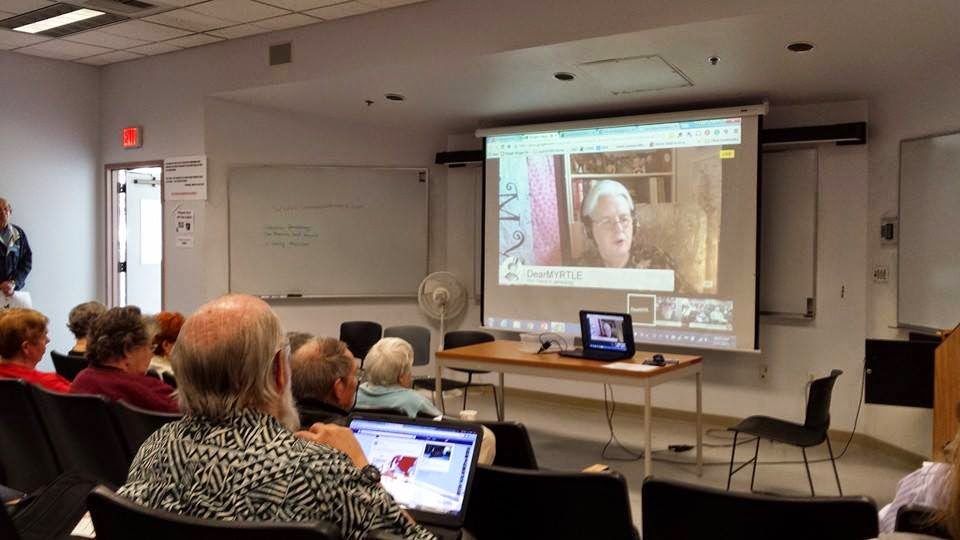
DearMYRTLE Visits CGSSD Virtually!

 Yesterday, DearMYRTLE visited CGSSD virtually via Google Hangouts On Air. Her presentation, "Google Hangouts: Enhancing Family Gatherings & Interviews", was enthusiastically received by our members present. This was our third "live" virtual presentation over the past few years. One of the nice features of Google Hangouts On Air is that it was recorded for future viewing.
DearMYRTLE
  While DearMYRTLE was broadcasting from Utah, Cousin Russ (Russ Worthington) was on hand to support and add additional information from his home in New Jersey. I might add that Cousin Russ gave me personal instruction about a week before the presentation and helped tremendously just before the meeting. Gary Hoffman, CGSSD's webmaster & Tech Guru was also very helpful, even having the right adapter to go from HDMI to the analog sound and projection system of our facilities.


Randy Seaver asking a question to DearMYRTLE


 I am definitely sold on using Google Hangouts. It's free and easy to use. I can think of a lot of uses this would be good for. I hope to find other speakers in the genealogical community that use this medium and have them present to us. 

 Resources from DearMYRTLE:
  • How to Hangout and Use Google+ http://bit.ly/MyrtsHowHangoutOnGoogle
  • Why Host Virtual Meetings http://bit.ly/MyrtsWhyHostVirtual

 Link to the recorded presentation: https://www.youtube.com/watch?v=SRFGQMEIbtE


Saturday, November 15, 2014

Cloud Genealogy Presentation

Here's a link to Gary Hoffman's presentation at the October Mini-Fair on the topic of Cloud Genealogy. This link will open a Google Presentation in your browser.
https://docs.google.com/presentation/d/14NyUWUc5_BW7vjHdzT-pL5NMpBWIHPOR_VEjaBkVpmM/edit?usp=sharing

Monday, September 8, 2014

CGSSD Meeting Notice

The Computer Genealogy Society of San Diego meets on the 3rd Saturday of each month (except December) from 9:00 a.m. to noon on the campus of UCSD, University of California, San Diego. See our web page www.cgssd.org  for directions.

The next meeting will be held on 20 September 2014 from 9:00 am to noon. Here are the details:

 9:00 AM  User groups: Ancestry.com with Del Ritchhart and DNA with Corlee Morris
10:00 AM Break, refreshments
10:20 AM Announcements followed up program: 

Dr. Joel Weintraub

"Crowdsourcing The Path To The 1950 U.S. Census"
The 1940 U.S. Census opened in 2012 without a name index.  A FamilySearch led consortium used 160,000 volunteers to name index that census in 4 months.  In addition, Joel and Steve Morse, over seven years with about 125 volunteers, developed free utilities to find which of 150,000 census districts someone was in, when a location or address is known.  These projects are examples of crowdsourcing.  Steve and Joel are now doing a similar project for the 1950 Census.  Joel will discuss differences between the 1940 and 1950 censuses that impacted their planning and project design.  The film scanning, publicity, volunteer response, Yahoo Group site, cloud storage, software, One-Step utilities, and project phases will be discussed.  All 233,800 1950 enumeration district definitions have now been transcribed.  Street indexes will also be completed for over 2,000 communities to help find 1950 census district numbers.


Joel Weintraub was born and raised in Manhattan. He is an emeritus Biology Professor at California State University, Fullerton and has won awards for his science teaching. He became interested in genealogy about 15 years ago, and volunteered for 9 years at the National Archives and Records Administration in southern California. Joel started transcribing streets within census districts in 2001 to help researchers search the 1930 U.S. Census (released in 2002). He was joined in the venture by David Kehs and Stephen Morse in 2002, and together, they have produced a number of online census searching utilities for both the federal and the New York State censuses on the Morse One Step Website. Joel produced locational finder aids for the 1940 census, and has given many talks on that census since 2006.  He now has the 1950 Census in his sights, scheduled to be released in 2022!  If you want to help with the 1950 project, email Joel at censusfiles@cox.net.


We meet at the Robinson Auditorium complex on the University of California, San Diego (UCSD) campus in La Jolla. From North Torrey Pines Road, turn at Pangea Drive into UCSD. Free parking is available in the parking garage on the left; use any space other than those specifically reserved for UCSD vehicles. Signs will mark directions to our meeting room. Please refer to our website www.cgssd.org; or the Graduate School of International Relations and Pacific Studies website (click here) for driving directions and a map.

Linda Brady
CGSSD VP-Admin

Friday, August 1, 2014

CGSSD Meeting Notice

The next meeting will be held on 16 Aug 2014 from 9:00 am to noon. Here are the details:

9:00: User groups: Roots Magic, with Chris Christensen; Macintosh, with Dona Ritchie.

10:00: Break, refreshments.

10:20: Announcements followed by program:

"Crafting Great Source Citations"
by Randy Seaver

    We all know that we should cite our sources, but it's hard to remember what goes first, what to include, punctuation, and more. Then the Internet came along and it's really complicated now. This presentation will cover source citation guides for genealogy, using content provider source citations, and using source citation templates in genealogy software programs to cite our sources.


    Randy Seaver is a native San Diegan. His ancestry is mainly colonial New England and Upper Atlantic, with some colonial German, French and Dutch forebears, and several 19th-century English immigrants. He has been pursuing his elusive ancestors since 1988, and has been online since 1992.
    Randy is a former President of the Chula Vista Genealogical Society and is currently the newsletter editor and research chair. He speaks to southern California societies, libraries and groups, and teaches "Beginning Computer Genealogy" adult classes at OASIS. He is a member of NGS, NEHGS, SCGS, SDGS, CGSSD and CVGS. Randy blogs daily about genealogy subjects at Genea-Musings (www.geneamusings.com) and the Chula Vista Genealogy Cafe (http://CVGenCafe.blogspot.com).

Wednesday, June 18, 2014

"Living on the Prairie" by Jamie Lee McManus Mayhew

[Jamie will be at CGSSD this Saturday to present "Across the Prairie: Land Records in the Public Land States".]


Living on the Prairie
By Jamie Lee McManus Mayhew

Hot summers, cold winters, dirt, bugs, mice, and snakes were an everyday part of living on the prairie during the expansion of our United States. Pioneers moving to the Great Plains soon realized that a log cabin was not going to be built on their homestead. Buffalo grass, a thick grass with heavily matted roots was to the prairie as trees were to the forest. Buffalo grass was the raw material available to build shelters for the new settlers. 
 http://en.wikipedia.org/wiki/Sod_house 

Many pioneers began their life on the prairie in a dugout cut into a hillside later to be expanded on several sides with sod to create a “cozy,” if not very clean, home. As time went on, the settlers would build an actual sod house with a door and windows. The laborious job of cutting sod with a spade was soon replaced with the use of the grasshopper plow which greatly eased the work of building a soddy. Strips cut approximately six inches deep and one foot wide by two feet long were used to build the walls. Laying the sod, grass side down and two to three rows wide, created a wall about three feet thick. A space was left for the door and windows were framed. Every few rows, the direction of the sod was changed to increase the strength of the wall. The roof was made in several ways most commonly by creating a wooden frame, sometimes covered with tar paper or straw, with a thinner layer of sod on top. Eventually, the roof might sprout a spring flower garden. Inside the house, the homeowner might hang cheese cloth from the ceiling to catch the bugs and grass that would drop down on the evening meal.
Library of Congress photo


The sod house was cool in the summer and warm in the winter although susceptible to heavy rain, they lasted a long time, frequently becoming a storage room or barn when a newer home was built. Wood was sparse so most of the soddies were heated with buffalo or cow chips. Eventually the family got used to the smell. Water was precious and hard to come by. Fortunate settlers settled near a spring or stream otherwise it was necessary to dig a well, a chancy and dangerous activity. Winter brought long days of loneliness with the nearest neighbor miles away.

We might think that this life was unimaginable and wonder why anyone would choose to live in this way but, although failure was high, the sodbusters brought settlement to the Great Plains by the early twentieth century thereby helping to expand the United States.

Sources:
“There are no renters here,” Homesteading a Sod House.  Women of the West Museum. http://theautry.org/explore/exhibit/sod/daily.html. (accessed 15 June 2014)
Vick Fite and Nancy Hendrickson, Frontier Traveler, The Kansas Soddy, http://www.frontiertraveler.com/kansas/the-kansas-soddy/. (accessed 15 June 014)
Sod house. n.d. http://en.wikipedia.org/wiki/Sod_house (accessed 15 June 2014)
Homestead Act: The Challenges of Living on the Plains. Nebraskastudies.org, , http://www.nebraskastudies.org/0500/frameset_reset.html?http://www.nebraskastudies.org/0500/stories/0501_0108.html (accessed 15 June 2014)

Homestead National Monument of America. National Park Service. http://www.nps.gov/home/index.htm (accessed 15 June 2014)

Wednesday, June 4, 2014

Family Tree Maker User Group Meeting 17 May 2014

Submitted by Ken Robison / FTM Group Leader


Here are the notes from our most recent meeting
 Together we know more than any of us alone.
FTM Users Group May 17 2014 

Getting into and out of trouble 

“Anyone can make a mistake to really mess things up you need a computer.” 

1. Open discussion              Questions, Problems, Issues or New Discoveries? 
2. Prepared discussion         Do you have two of the Same Tree?
    The Robison Taylor Family Tree.ftm
    The Robison Taylor Family Tree1.ftm

Step one Make a backup of both or all trees and name files so you can distinguish between/among them

Create Reports (In Publish)

1. Select “List of individuals Report”

                Review available reports

                        Click Create Report

                   Under List of Individual Report Options Individuals to include: All Individuals

             Set Report Title to File Name ( Robison Taylor Tree 1 Listing)

         Print out or save report to review and compare details to see if all individuals are in both trees

Note: To Switch between Reports Click on Collections to display available reports

2. Select “Media Usage Report”

Click Create Report

Under Media Usage Report Options Individuals to include: All Individuals 
There are many choices for Items to include and Filtering. Review the options and test 
effect by generating reports and see if anything is missing when items are selected or 
de-selected. 

Note: Like in Individuals Report above Use Report Title to Identify the File (RobTay_FT1)

If you find that one file has different information or individuals you can merge those individual records into the tree you want to be your master or complete file.

Once you are confident that you have all the information in one file you can rename that file, back it up and if you are brave (or foolhardy?) delete the unwanted file. Hover over file name and select option. If you select Delete you will be prompted for your Ancestry password before deletion.
Once deleted the file cannot be recovered! 

Resources: FTM Help Menu/Tutorials, Online videos–You-tube FTM, google The Barefoot Genealogist great short topics

Discussion:
Beyond the Basics A Guide for Advanced Users of Family Tree Maker 2011 Pgs. 74-80
1. Creating a file from a PC for use on a Mac
        Knowledge Base on www.familytreemaker.com
              Click on Technical Support, enter “5313” in search to get Mac Migration Utility
2. Moving Tree to a new Computer
3. Maintaining a tree on Two Computers (e.g. Desktop and Laptop..Husband & Wife or Cousin on different computers.

See you next time at the FTM meeting...


Saturday, May 10, 2014

Found photos

While perusing an antique shop in South Park on Mother's Day weekend, I discovered many old photos for sale as "ephemera." They were once someone's family photos and now they are just curiosities. I flipped over a few of them and was not surprised to find most had no legends at all.

However, I did find a great old photo that had some IDs on the back. It told the name of the man in the photo and listed his children. I knew I had to buy it and try to get it back to his family.

Here's the photo:

As you can see from the front and back of this photo, there is lots of good genealogy information here. When I got home, I searched in FamilySearch to see if I could find this John Rhodes in Wisconsin.

Sure enough, I found census records for him and his family in 1870 and 1880. John was born in England and married Mary Wiltze from Oneida, New York apparently after coming to America. They were in Trempealeau, Wisconsin, in the 1870s. He is clearly enumerated in both censuses.

However, someone had given his Family Tree profile an estimated death date of 1869.

 I uploaded this photo to FamilySearch and tagged his image so that it appears on the Family Tree. Now the photo is no longer lost. I'm contemplating other places to post the photo so that descendants might find it.

 Where do you think I should post it?

Friday, April 25, 2014

DNA Genealogy by Corlee Ann Morris

For the first DNA Genealogy contribution to our new COMPU.GEN Blog, I would like to cover three topics.
First Topic:  Family Finder DNA Projects.  The original DNA Projects when testing became available were focused on Surname Projects.  Now that Autosomal DNA testing is available, the structure of a Surname Project is not a good fit.  So now Projects based on the Family Finder results are being developed.  FTDNA just came out with some guidelines for Group Administrators on Family Finder Groups.

Second Topic: In the twentieth Century we have had an amazing increase of technological development.  Computer electronics have been constantly getting more powerful and cheaper.  Now the things we study with computers have been speeding along at a faster and faster pace as well.  Beyond traditional genealogy research, many tools have become available to assist in our quest for knowing all we can know about our family connections.  Genetic Genealogy has advance so far that CeCe Moore says that we can build a family tree based on DNA testing.  The Autosomal DNA testing is adding to our ability to make connections where paper trails quit.  There is a movement in the genealogy world that parallels much of the Citizen science currently in vogue.  Citizen science is research conducted by interested amateurs. People have become so fascinated by what our genes can tell about ourselves that they are creating innovative tools to analyze DNA testing results.  I hope to share these with you as I learn how to use them.   

Third Topic:  A new area of exploration involves what is called the “x” Chromosomes.  The males have only one “x” while the female has two (one from her father and one from her mother).   The “x” chromosomes are not the same things as the mtDNA.  An “x” Chromosome is a chromosome, while the mtDNA is/are DNA material(s) found with in each cell. Mitocondria1  is a specific organelle in the cell that helps it to produce energy. The mtDNA2 is the genetic material found in mitochondria.  How the males “x” chromosome manifests itself and how the female “x” chromosomes manifests themselves yields some surprising information.  I am doing more research on this subject. More to be explored later.   

1 &2(From the Glossary at www.familytreedna.com)


Corlee Ann Morris
CGSSD Board Member and past President.

Wednesday, March 19, 2014

Scottish Research Comes To CGSSD in April

Professional Genealogist Judy Brooks will be presenting a one hour session on Researching Your Scottish Ancestors at the Computer Genealogy Society of San Diego on April 19th, 2014. Ms. Brooks will be discussing some lesser known internet websites for use in your Scottish and Scots-Irish research.

Bio for Judith Brooks
Find Dem Bones  
finddembones@aol.com

 Judy is the wife of North County Scots Chaplain Bill Brooks and has been researching both her own and her husband's ancestry since 1995 when he began looking for his tartan and proof of his Scottish heritage.
As both families were in the United States in Colonial times, she has done extensive research in Virginia, Pennsylvania, Ohio, Illinois, Kentucky, and Nebraska which has led her to additional research in Ireland and Scotland.

 She is a member of the Association of Professional Genealogists, National Genealogical Society, Southern California Genealogical Society, Nebraska Genealogical Society and an active member of the Carlsbad San Diego North County Genealogical Society.

 Judy has experience researching various libraries, county court houses, cemeteries, historical societies, the National Archives, DAR, and the Library of Congress for her own family research as well as for clients.
Her philosophy is that there is so much more to our ancestry than just the historical dates and places.

 Finding the history of the time and place and information about the life and times of our ancestors brings full meaning to our heritage.

Wednesday, February 5, 2014

RootsTech 2014 Is Here!

Can't make it to Salt Lake City this year to attend RootsTech? No worries. The organizers at FamilySearch have graciously allowed 15 of it's presentations to be viewed "live" online starting tomorrow at 8:30 am pacific time. For the next 3 days you can hear some of the top genealogists in the world give their presentations like your right there in the classroom with them.

To view the live online stream simply go to RootsTech and follow the instructions.

What about the syllabi? Well, for a short time you can download all the syllabi or just the sessions you want by clicking here. It's like getting a whole book on genealogy for free! You can't beat that.


Following are the broadcasted sessions and speakers. All times are in pacific standard time (PST):

Thursday, February 6
8:30 a.m. to 10:30 a.m., Top 10 Things I Learned About My Family from My Couch by Tammy Hepps
12:00 p.m. to 1:00 p.m., FamilySearch Family Tree: What's New and What's Next by Ron Tanner
1:30 p.m. to 2:30 p.m., Intro to DNA for Genealogists by James Rader
3:00 p.m. to 4:00 p.m., Genealogy in the Cloud by Randy Hoffman
4:00 p.m. to 5:00 p.m., Sharing Your Family with Multimedia by Michael LeClerc
Friday, February 7
9:30 a.m. to 10:30 a.m., Storytelling Super Powers: How to Come Off as Your Family's Genealogy Hero by David Adelman
12:00 p.m. to 1:00 p.m., Tweets, Links, Pins, and Posts: Break Down Genealogical Brick Walls with Social Media by Lisa Alzo
2:30 p.m. to 3:30 p.m., Getting the Most Out of Ancestry.comby Crista Cowen
3:00 p.m. to 4:00 p.m., Finding Family and Ancestors Outside the USA with New Technologies by Daniel Horowitz
4:00 p.m. to 5:00 p.m., Do It Yourself Photo Restoration by Ancestry Insider
Saturday, February 8
9:30 a.m. to 10:30 a.m., Become an iPad Power User by Lisa Louise Cooke
12:00 p.m. to 1:00 p.m., Information Overload: Managing Online Searches and Their Results by D. Josh Taylor
1:30 p.m. to 2:30 p.m., A Beginner’s Guide to Going Paperless by Randy Whited
3:00 p.m. to 4:00 p.m., How to Interview Yourself for a Personal History by Tom Taylor
4:00 p.m. to 5:00 p.m., Five Ways to Do Genealogy in Your Sleep by Deborah Gamble